

Every once in a while, medicine reminds us that the human body is still more mysterious than we like to admit.
We tend to think of anatomy as settled science. The heart pumps blood. The lungs exchange oxygen. Muscles move bones. Skin covers the body. Fat stores energy. Fascia holds things together. Surgeons spend years learning these layers, moving through them carefully, respecting them, repairing them, and reshaping them. A recent New York Times Magazine article about the interstitium, a recently discovered third bodily system for the circulation of fluids.
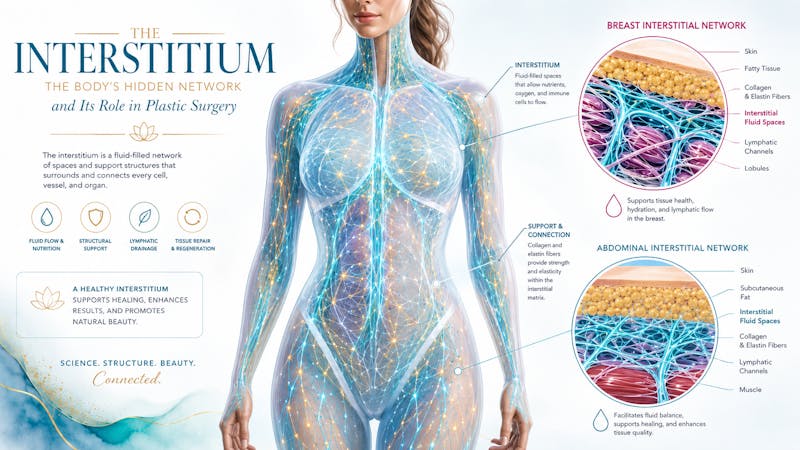
This internal “knitted blanket” highlights something fascinating: there may be an entire body-wide “in-between” space that we have underappreciated for a very long time. Not a mystical concept. Not a marketing buzzword. A real anatomical and physiological system made up of fluid-filled spaces, collagen, elastin, connective tissue, and pathways that help tissues communicate, swell, heal, drain, scar, and recover. And for those of us who perform breast and body plastic surgery, this is not just an academic curiosity. It helps explain something I have seen throughout my career: great plastic surgery is not only about removing skin, tightening muscle, placing an implant, or suctioning fat. It is about understanding how living tissue behaves.
The Body Is Not Just Parts. It Is a Connected System.
In plastic surgery, patients often come in thinking about one specific area: the abdomen after pregnancy, the breasts after weight loss, the arms after aging, the thighs after major body changes, or the waistline that never seems to respond to diet and exercise. That is understandable. We all look in the mirror and notice individual areas. But surgery teaches you that the body does not work in isolated parts. The abdomen is connected to the flanks. The breast is connected to the chest wall, skin envelope, fascia, lymphatic drainage, and posture. The waistline is affected by skin elasticity, fat distribution, muscle tone, scar tissue, swelling, hormones, and genetics. The skin is not simply a sheet. Fat is not simply padding. Fascia is not simply wrapping paper.
The interstitium gives us another way to think about this. It is part of the body’s internal environment, the space between cells and tissues where fluid, signaling molecules, immune cells, and nutrients move. It is where swelling begins, where inflammation is processed, where lymphatic drainage starts, and where healing unfolds. Cleveland Clinic describes the interstitium as a network of fluid-filled spaces that cushions organs, helps move nutrients and waste, supports lymphatic drainage, and contributes to wound healing. That matters after surgery.
Swelling Is Not a Side Effect. It Is Biology.
Almost every cosmetic surgery patient asks some version of the same question: “How long until the swelling is gone?”
That question is especially common after liposuction, tummy tuck, breast surgery, mommy makeover, body lift, arm lift, thigh lift, and revision procedures. The honest answer is that swelling is not simply “extra water.” It is the visible expression of tissue injury, inflammation, lymphatic interruption, fluid shifts, and healing. When we perform liposuction, we are not just removing fat. We are passing small cannulas through living tissue. That tissue has blood vessels, lymphatic channels, connective tissue scaffolding, nerves, collagen fibers, and interstitial fluid spaces. Even with meticulous technique, the body responds with swelling.
That swelling can feel firm, uneven, tight, or lumpy early on. Most of the time, this is not the final result. It is the body reorganizing itself. The same is true after abdominoplasty. During a tummy tuck, skin and fat are elevated, excess tissue is removed, the abdominal wall is often tightened, and the skin is redraped. This is a powerful operation, but it also temporarily disrupts normal fluid movement. That is why compression garments, drains in selected cases, careful activity restrictions, hydration, walking, and time all matter. A patient may see a beautiful early improvement in shape, but the final refinement often takes months because the interstitium, lymphatics, collagen, and fascia all have to settle.
Liposuction Is Really Sculpture Through Connective Tissue.
When people think about liposuction, they often imagine fat being removed like liquid from a container. That is not really how it works. Fat lives in compartments. Those compartments are supported by connective tissue. Some areas are soft and forgiving. Others are dense and fibrous. The upper abdomen is different from the lower abdomen. The flanks are different from the back. The male chest is different from the female waist. The inner thigh is different from the lateral thigh. This is why experience matters so much. Liposuction is not just about how much fat is removed. It is about how evenly the remaining tissue is treated, how well the skin can contract, how much structural support remains, and how the tissue will heal.
Aggressive liposuction in the wrong patient can create contour irregularities, loose skin, firmness, prolonged swelling, or scar-like internal tethering. Conservative liposuction in the wrong patient may not produce enough change. Technologies like VASER liposuction, power-assisted liposuction, and energy-based contouring can be helpful in selected patients, but they are tools. The real art is knowing how tissue will respond. A young patient with thick, elastic skin and localized fat behaves very differently from a patient with stretched skin after pregnancy or major weight loss.
The interstitium reminds us that the “space between” is not empty. It is part of the result.
Breast Surgery Depends on the Skin Envelope, Soft Tissue, and Internal Support.
Breast surgery is another area where this concept becomes very practical. In breast augmentation, patients often focus on implant size, implant type, and cup size. Those are important, but they are only part of the decision. The final result depends on the patient’s existing breast tissue, chest wall shape, skin stretch, fold position, nipple location, soft tissue thickness, and internal support. This is why two patients can choose the same implant and look completely different. The breast is not just a container for an implant. It is a living soft-tissue structure. The skin envelope has to stretch appropriately. The lower pole has to accommodate the implant.
The fold has to be respected or adjusted carefully. The soft tissue has to provide coverage. The body has to form a normal capsule around the implant. The surrounding tissues have to heal in a stable way. In breast lift and breast reduction surgery, we are even more directly working with skin, glandular tissue, fat, fascia, blood supply, and wound healing. The goal is not only to make the breast smaller or higher. The goal is to reshape the breast in a way that can hold up over time. That means respecting blood flow, minimizing unnecessary trauma, reducing tension on incisions, and creating a shape that works with the patient’s tissue rather than fighting against it.
Scars Are Not Just Lines. They Are Remodeling Collagen.
Patients understandably worry about scars. In breast and body surgery, scars are often the trade-off for better shape. A tummy tuck scar may allow removal of loose abdominal skin. A breast lift scar may allow correction of sagging. An arm lift or thigh lift scar may allow removal of skin that no non-surgical treatment can adequately tighten. But scars are not simply marks on the skin. They are the end result of wound healing, collagen deposition, inflammation, genetics, tension, and time. Research on wound healing shows that adult wounds heal through organized phases, and abnormal extracellular matrix remodeling can contribute to hypertrophic or keloid scars.
This is why surgical planning matters so much. The incision should be placed thoughtfully. The closure should reduce tension when possible. The patient’s history of scarring should be considered. Nicotine must be avoided. Nutrition matters. Postoperative scar care matters. And patience matters. A scar at six weeks is not a final scar. A scar at three months is not a final scar. Many scars continue to mature for a year or longer. The redness fades. The firmness softens. The collagen remodels. The body keeps working long after the stitches are gone.
Mommy Makeover Surgery Is Really a Tissue Restoration Operation.
The phrase “mommy makeover” can sound casual, but the operation is anything but casual. Pregnancy can stretch the abdominal skin, separate the rectus muscles, change the breast volume, thin the breast tissue, expand the skin envelope, and alter fat distribution. Weight changes and breastfeeding can add another layer of complexity. A mommy makeover may include a tummy tuck, breast augmentation, breast lift, breast reduction, liposuction, or other contouring procedures. The goal is not to create an artificial body. The goal is to restore proportion, support, and confidence.
From the interstitium perspective, this is a major healing event.
Multiple areas may be treated at once. Swelling may move downward with gravity. Lymphatic drainage may be temporarily altered. The abdominal wall may feel tight. The breasts may sit high before they settle. The waist may look dramatically better early, but still refine over months. This is why I spend so much time talking with patients about recovery. A mommy makeover is not a weekend procedure. Many patients need several weeks before they feel functional and about a month before they are doing many normal daily activities, depending on the extent of surgery and their individual healing. Exercise, lifting, core work, and strenuous activity take longer. The operation may happen in a few hours, but the result develops over months.Skin
Tightening Depends on Collagen, Elasticity, and Realistic Expectations.
Non-surgical and minimally invasive skin-tightening technologies also make more sense when we think about connective tissue and the interstitial environment. Treatments such as radiofrequency microneedling, Morpheus8, Quantum RF, laser resurfacing, and other energy-based devices work by creating controlled injury or controlled heating in the skin and soft tissue. The purpose is to stimulate collagen remodeling, improve texture, tighten mild laxity, and enhance skin quality. These treatments can be excellent for the right patient. But they do not replace surgery when there is significant loose skin.
A device can improve collagen behavior, but it cannot remove a large apron of abdominal skin after pregnancy or massive weight loss. It cannot fully correct breast ptosis. It cannot do what a tummy tuck, breast lift, or body lift can do. The key is matching the treatment to the biology. Mild laxity may respond beautifully to energy-based tightening. Moderate to severe laxity often requires surgical correction. Many patients benefit from a combination approach: surgery for structure and shape, then non-surgical treatments for skin quality, texture, and refinement.
The Best Results Respect the Body Instead of Forcing It.
One of the most important lessons in plastic surgery is that tissue has memory. Skin that has been stretched behaves differently. Scar tissue behaves differently. Previously operated tissue behaves differently. Post-weight-loss tissue behaves differently. Sun-damaged skin behaves differently. Thin breast tissue behaves differently than dense breast tissue. The interstitium adds another layer to this understanding.
It is a reminder that the body is not just a mechanical object. It is a living, fluid, responsive system. This is why the best plastic surgery is never just technical. It is judgment-based. It requires knowing when to be aggressive and when to be conservative. When to combine procedures and when to stage them. When liposuction is enough and when skin removal is necessary. When an implant will help and when a lift is required. When a patient’s expectations are realistic and when they need a more honest conversation. Plastic surgery can do remarkable things, but it works best when it cooperates with anatomy.
A More Connected View of Beauty and Healing.
What I found most interesting about the discussion around the interstitium is not whether it should be called an organ or not. That debate is less important to me than the larger point: the body is connected in ways we are still learning to understand. For breast and body surgery patients, this should be reassuring. It means that swelling, firmness, scars, and gradual changes are not signs that something is “wrong” most of the time. They are signs that the body is healing through a complex and highly organized process. It also means that surgical technique, postoperative care, compression, movement, nutrition, lymphatic health, scar management, and patience all matter.
At Holcomb-Kreithen Plastic Surgery & Medspa, our goal is not simply to perform a procedure. It is to help each patient choose the right procedure, at the right time, for the right anatomy. Whether that means breast augmentation, breast lift, breast reduction, tummy tuck, VASER liposuction, mommy makeover, or non-surgical skin tightening, the best outcomes come from respecting the deeper biology beneath the surface. Because beauty is not only about what we remove, tighten, lift, or enhance. It is also about how well the body heals, how naturally the tissues settle, and how thoughtfully we work with the hidden layers that make us who we are.
by Joshua C. Kreithen, MD – Board-Certified Plastic Surgeon
Joshua C. Kreithen, MD is a board-certified plastic surgeon at Holcomb Kreithen Plastic Surgery and MedSpa in Sarasota, Florida. With advanced training in aesthetic plastic surgery, Dr. Kreithen is recognized for his expertise in breast and body contouring, mommy makeover and comprehensive cosmetic surgery of the body after weight loss.
Known for his surgical precision and patient-focused approach, Dr. Kreithen combines artistic vision with the latest techniques to help patients achieve natural, balanced, and lasting results. From breast augmentation and lifts to body sculpting procedures such as liposuction and abdominoplasty, he customizes each treatment plan to the individual’s goals and anatomy.
Dr. Kreithen has earned a reputation for excellence in both surgical outcomes and compassionate care. Patients choose him not only for his technical skill, but also for his dedication to safety, innovation, and personalized attention—qualities that make him a trusted choice for those seeking transformative, confidence-boosting results in Sarasota and beyond.